
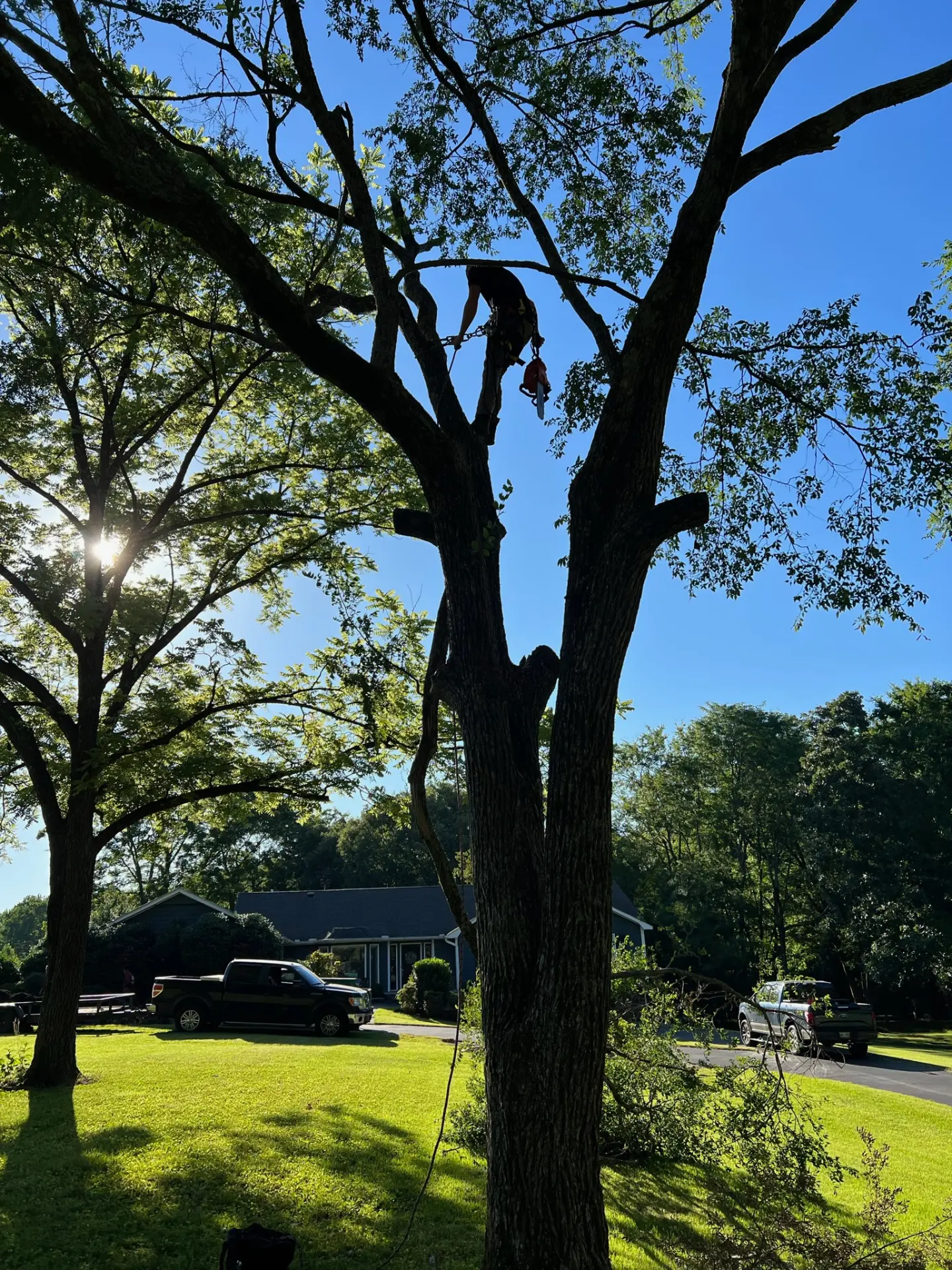
Every cut has a reason.
We never top a tree.
We prune mature hardwoods in Memphis, Germantown and Collierville to the ANSI A300 standard — cuts at the collar, weight taken off the ends where the risk is, and never more canopy than the tree can afford to lose.
- Family owned and operated
- Licensed & insured
- Climbed and hand cut
The pruning types
and what each one does
Most people call and ask for a trim. These are the five jobs that word actually covers, so you can tell us which one you're after.
Crown cleaning
Dead, dying, diseased and broken limbs taken out of the canopy, plus hangers left over from the last storm. Nothing live comes off, so it costs the tree nothing, and it removes the pieces most likely to land on a car or a walkway. This is the default first visit on a tree we have not worked before.
Crown thinning
Selective removal of a small amount of live interior growth so wind moves through the canopy instead of pushing against a solid sail, and so grass and beds underneath get some light. Done right, the silhouette of the tree does not change — you should not be able to tell from the street that anyone was up there.
Crown raising
Lifting the bottom of the canopy for clearance: off the roof plane and out of the gutter line, high enough over the driveway for a truck, clear of the walkway so nobody ducks, and back from sightlines at the end of the drive. We raise gradually, because taking too many low limbs at once shifts weight to the top and leaves a long bare trunk.
Crown reduction
Shortening limbs back to a living lateral branch big enough to take over as the new leader. This is the honest way to make a tree smaller — it keeps a natural shape and leaves cuts the tree can seal. It is slower and more expensive than topping, and it is the reason the tree is still standing in twenty years.
Structural pruning on young trees
The cheapest work we do. On a tree under about fifteen years we pick a single dominant leader, remove competing codominant stems and tight narrow forks before they get big, and space the scaffold limbs out along the trunk. Twenty minutes of cutting now prevents the split that would otherwise take out half the tree in a storm three decades from now.
We don't top trees.
Not for anybody.
Topping means sawing limbs off at a convenient height, in the middle of the wood, with no regard for where the next living branch is. It is fast, it needs no skill, and it is the single most damaging thing that gets done to trees in this region.
What happens next is predictable. A topped tree panics and pushes a dense flush of shoots out of the stubs. Those shoots grow from just under the bark rather than out of a proper branch union, so they are anchored to a shell of decaying wood — and they grow fast, which means within about five years the tree is as tall as it was, twice as thick with weak wood, and far more likely to shed a limb than it was before anyone touched it.
The stubs themselves never close. A cut in the middle of a limb has no branch collar to seal it, so the wound stays open and decay walks down the stem year after year. You also pay again sooner, because that regrowth has to be dealt with on a much shorter cycle than a properly pruned tree.
If your tree genuinely needs to be smaller, the answer is a crown reduction cut back to laterals that can take over, or the tree is simply too big for where it stands and the honest answer is removal. We'll tell you which one it is at the estimate, including when that is not the answer you wanted. We would rather lose the job than leave a hazard behind with our name on it.
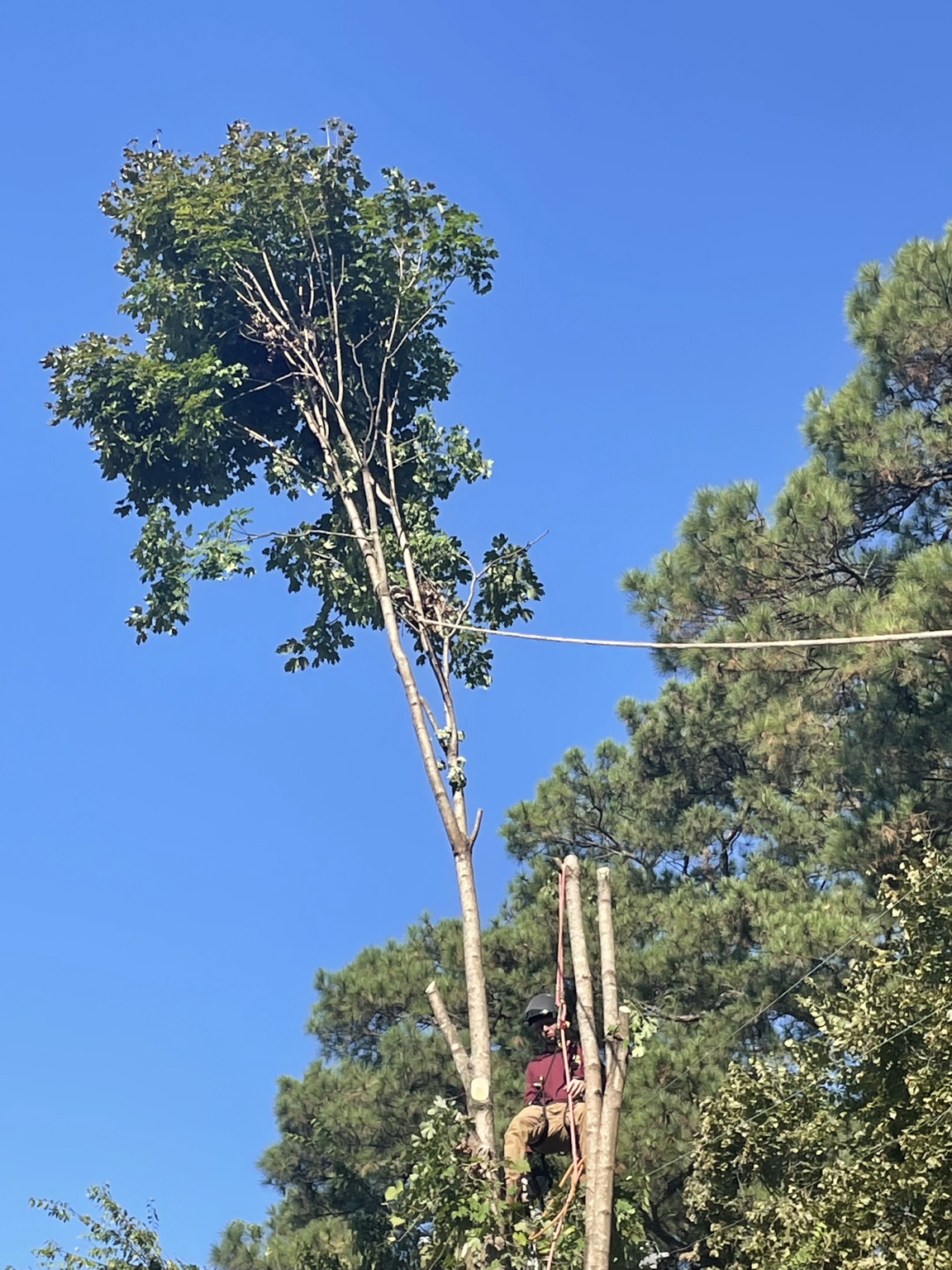
Hand cut from the rope,
one limb at a time
No spikes in a tree we're keeping, no bucket where the limbs are too far out to reach. The climber moves to the cut, so every branch comes off at the right place.
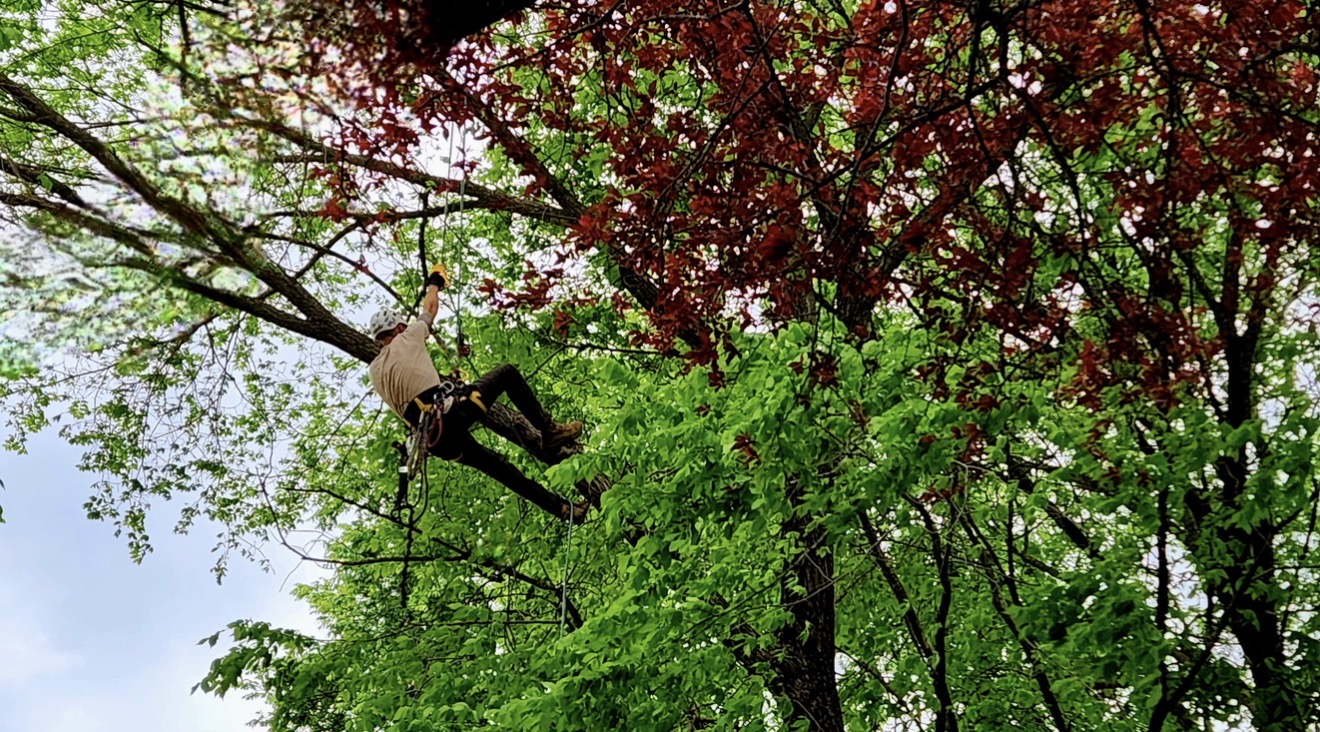
When to prune
around Memphis
Season changes what a cut costs the tree. It is worth waiting a few months for most work, and worth not waiting at all for the rest.
Dormant season, November through February
This is the general window for structural work, thinning and reduction. The tree is not spending energy on the canopy, so it gives up very little to the cuts, and the wounds start closing the moment growth resumes in spring. Bare limbs also mean we can actually see the architecture — crossing branches, weak forks and old damage that a full canopy hides in July.
Oaks: not in spring or early summer
Oak wilt moves between trees on sap beetles that are drawn to the smell of a fresh cut, and they are active in the warm months. This region carries that pressure, so oak work gets scheduled in the dormant window as a rule. If an oak has to be cut in season for a safety reason, we do it and seal the wound the same hour rather than leaving it open.
Storm damage: whenever it happens
A cracked limb or a hanger over the driveway is not a seasonal decision. Broken wood comes out as soon as we can get there, in any month, because the tree is already wounded and the piece is already going to fall — the only question is what is under it.
Storm and emergency workHow much canopy
comes off in one visit
On a healthy mature tree we take no more than about a quarter of the live canopy in a single visit, and usually a good deal less. On an older tree, one that is already stressed, or one that has been through construction or drought, the ceiling drops closer to ten or fifteen percent.
The reason is simple: leaves are the tree's food supply. Every leaf we remove is production the tree no longer has, and it has to pull from stored reserves to rebuild. Strip too much at once and you get a tree that is spending down its savings — thin new growth, weak defense against borers and fungus, and dieback in the top a couple of seasons later. Plenty of trees that "never recovered from the storm" actually never recovered from what was done after it.
So when a tree needs a big change — real size reduction, or a canopy that has not been touched in fifteen years — we stage it across visits a year or two apart. You get most of the benefit on the first trip, the tree gets time to respond, and we finish the job on the second. We'll map that plan out at the estimate so you know what is happening now and what is happening later.
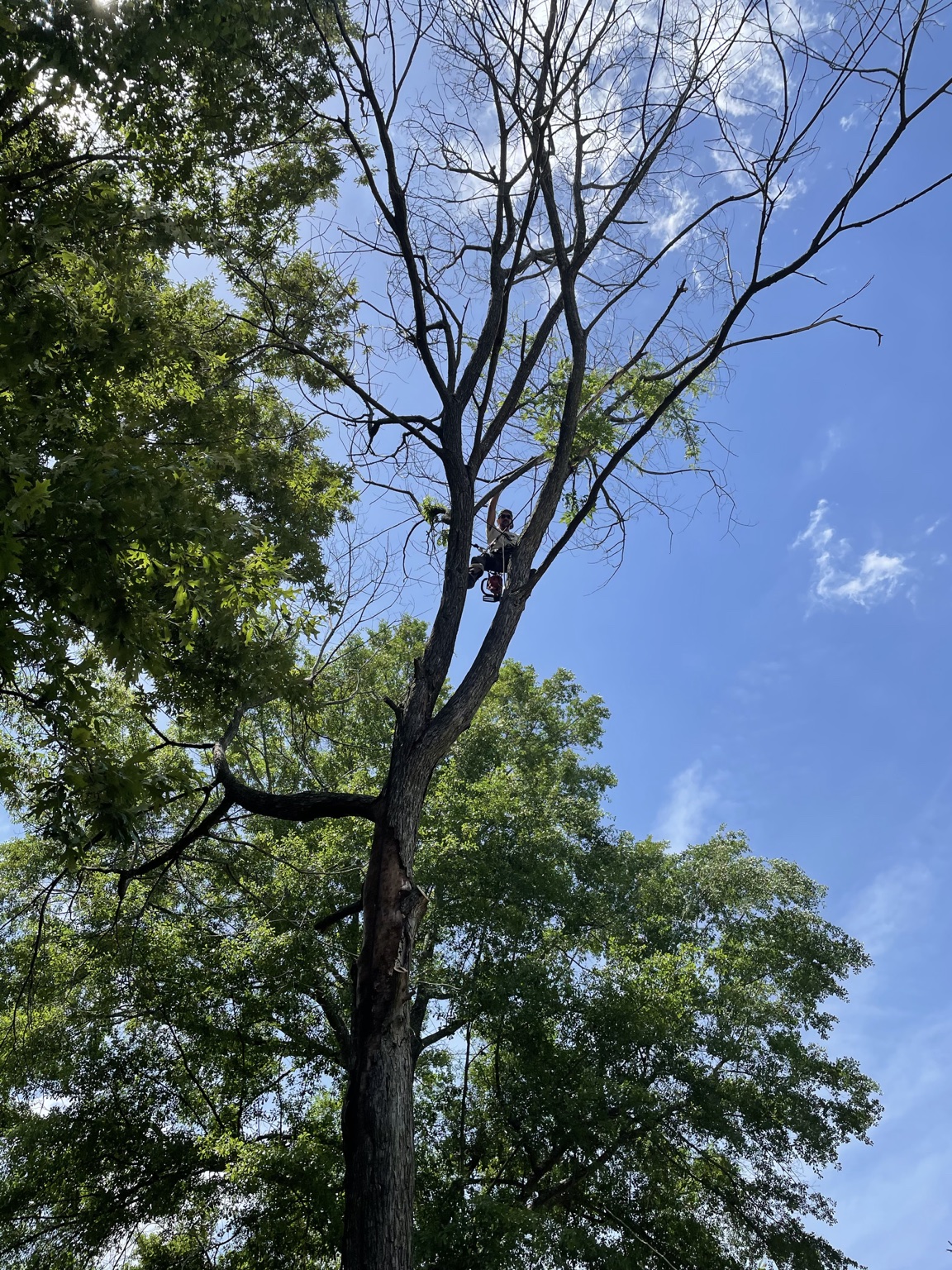
Getting limbs off
the things they're rubbing
Most pruning calls start here — something is touching the house, blocking the drive, or hanging where it shouldn't.
Roof and gutters
Limbs resting on shingles scrub off the granules every time the wind blows, and branches hanging over the gutter line keep the trough packed all fall. We pull the canopy back off the roof plane with a margin for growth, so you are not calling us again in eighteen months.
Driveway and sightlines
Enough height over the drive for a delivery truck without scraping, and low growth cleared where you pull out onto the street so you can see traffic coming. Same for anything blocking a stop sign or a streetlight at the curb.
Walkways and doors
Head clearance on the front walk, around the porch, along the fence line and over gates. Small cuts, quick visit, and it stops the daily duck under a wet branch.
The service drop to the house
The line running from the pole to your weatherhead is on your side of the meter, and we will clear growth off it when it can be done safely. What we do not touch is anything on the utility side — primary lines between poles, transformers, or the pole itself. That work belongs to the power company's line clearance crew, and we will tell you who to call and what to ask for rather than guessing at it.
What people ask
before we climb
What's the best time of year to prune in Memphis?
Roughly November through February. The canopy is bare, so the structure is easy to read, the tree is dormant and loses very little stored energy to the cuts, and the wounds close as growth starts in spring. Oaks in particular belong in that window because of oak wilt. The exceptions are deadwood and anything hanging where it can hurt somebody, which comes off whenever we find it.
Why won't you top my tree if I ask you to?
Because topping does not make a tree smaller for long and it makes it more dangerous. Cutting back to stubs removes the branch collars the tree needs to seal, and it answers with a burst of fast, weakly attached shoots that are taller than the original limbs within a few years. Meanwhile decay works down the open stubs. If the tree genuinely needs to be smaller we do a crown reduction to proper lateral branches, and if it is too big for the spot to begin with, we will tell you it is a removal even when that is not what you were hoping to hear.
How often should mature trees be pruned?
Most established hardwoods around Germantown and Collierville do well on a three to five year cycle — enough to keep deadwood out and clearance held without cutting live wood every year. Young trees benefit from a light structural visit every two or three years while the branch architecture is still being set. Fast growers over a roof, and anything that took storm damage since the last visit, get looked at sooner.
Can you clear limbs off my roof and gutters?
Yes, and it is one of the most common calls we get. We raise the canopy off the roof plane so limbs are not sweeping the shingles in the wind, pull branches back from the gutter line so the trough is not filling with leaves and twigs all fall, and open up the valleys where debris tends to pack in. We also clear the service drop coming to the house where it is safe for us to do it.
Do you prune fruit trees?
We do light structural and clearance work on backyard fruit trees — deadwood out, crossing limbs cleaned up, a crowded center opened so air and light get in. What we do not do is intensive production pruning aimed at maximizing yield, which is a different discipline on a different schedule. If your goal is a bigger harvest rather than a healthier, safer tree, we'll tell you that at the estimate.
Related
services
Tree Removal
Full removals in tight spots and open yards alike.
Storm Damage
A tree on the house, the car, or the driveway. Answered 24/7.
Stump Grinding
Stumps ground below grade so the spot can be planted or mowed over.
Tree Care
For damaged or aging trees that are worth keeping.
Sod Installation
Ground prepped and graded, sod laid, watering instructions so it takes.
Want it pruned right
the first time?
We'll walk the tree with you, say what it needs and what it doesn't, and write the number down. Memphis, Germantown, Collierville and the rest of the route.
ANSI A300 pruning so the tree recovers instead of growing back wrong. Storm and emergency calls answered 24/7.