
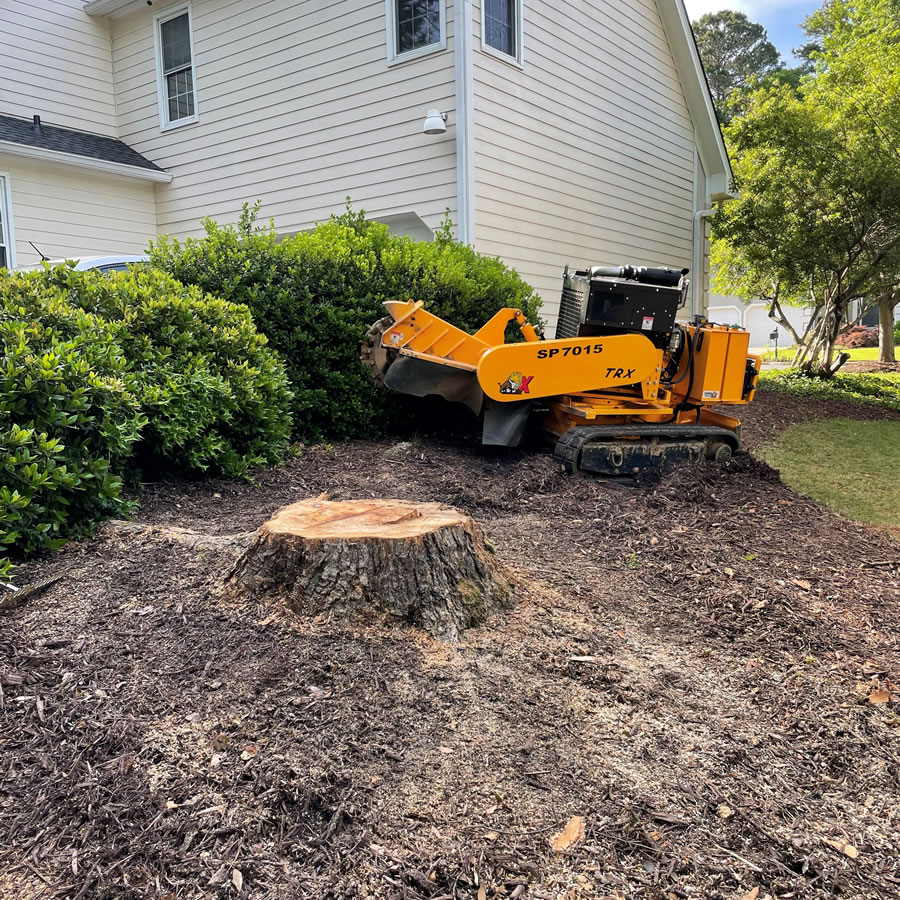
Below grade,
not flush.
We grind stumps below grade and leave the spot flat and ready, from Memphis and Germantown out to Collierville and across the state line — ready to plant, sod, or mow over.
- Family owned and operated
- Licensed & insured
- Utilities located first
The stump
The yard
Grinding vs.
full stump removal
They get talked about as the same service. They are not, and one of them is wrong for almost every yard.
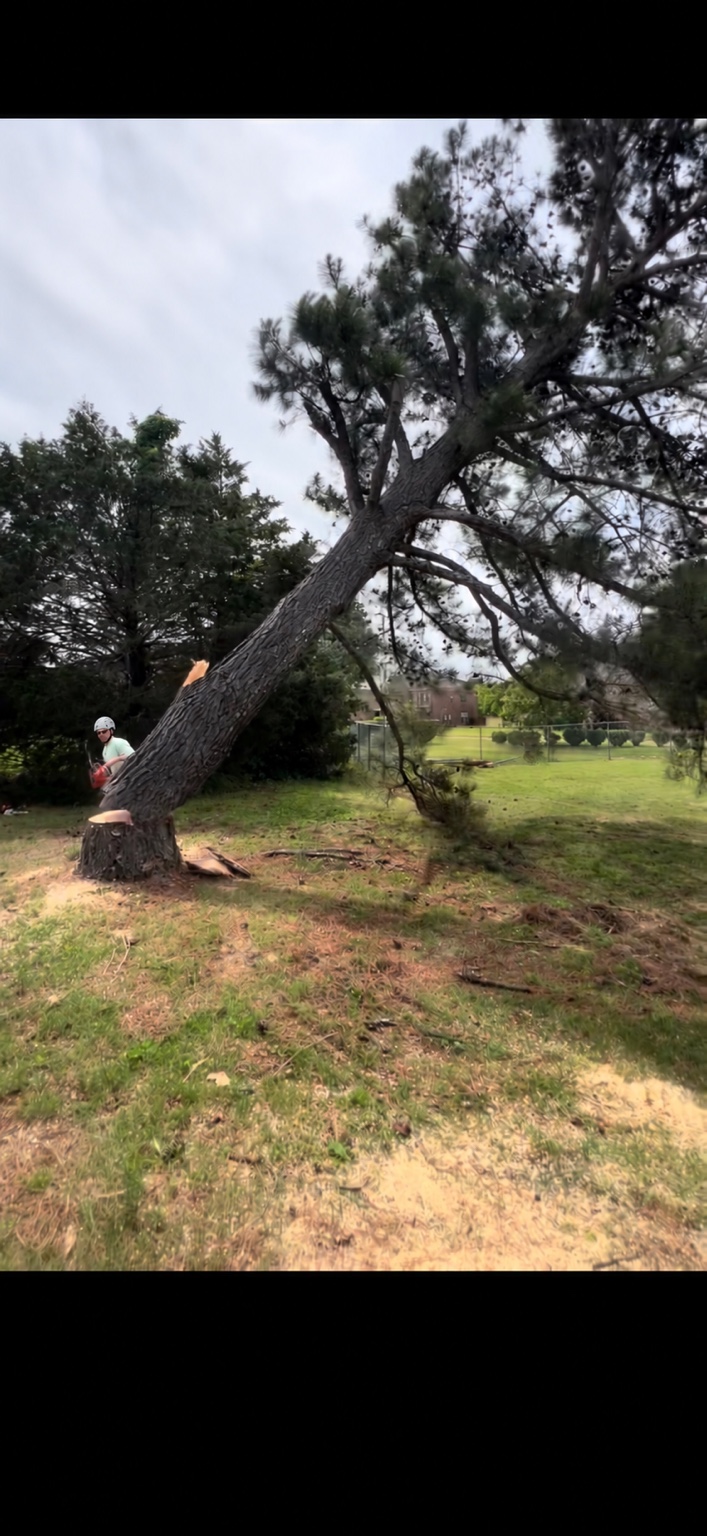
Grinding uses a carbide cutting wheel to chew the stump down below the soil line. The root system stays in the ground and decays on its own over the next several years, which nobody ever notices because it is happening under intact lawn. The disturbed area is barely wider than the stump was.
Full removal — excavation — means pulling the whole root plate out of the ground with a machine. It leaves a crater instead of a divot, tears up a much larger area of yard along with whatever irrigation or bed edging is in the way, needs equipment that has to get in there, and costs considerably more.
Excavation earns its price in a handful of situations: a footing, driveway or patio going in over the spot, a foundation or hardscape conflict, or a new tree going in that exact location rather than a few feet over. Outside of those, grinding is the right call and we will say so — there is no version of this where we talk you into the bigger machine because the invoice is bigger.
How deep we go,
and what you get back
How deep we go
Six to ten inches below grade is the standard for lawn and mulch beds. That puts the spot far enough under the soil line that you can seed it or mow over it and never know a stump was there.
When sod is going down over the spot, or you are planting something nearby, we go deeper and take more of the flare and upper laterals with it so the new root zone is not fighting old wood.
Depth has a practical floor, though, and it is set by what is in the ground rather than by what we would like. Around here that means chert and gravel, wall footings, big structural roots running under a walk, irrigation lines, invisible fence, and landscape lighting runs. When the wheel finds one of those, we stop and tell you rather than grinding through it.
What the finished spot looks like
Once we are done, the stump is gone below grade and the yard is cleaned up before we leave. What is left is a flat, level spot you can walk across without catching a toe on old wood.
That spot is ready for what comes next — grass seed, sod, mulch, a garden bed, or just the mower running straight over it without steering around anything.
Memphis lawns settle a little over the following weeks as things break down under the surface, which is normal. A light top-off gets it level again and you are done.
Access is what
changes the quote
Two identical stumps in two different yards are two different prices, and this is almost always why.
A standard gate is all we need
Roughly a 36-inch clear opening lets the normal machine walk straight to the stump, and that is the quote you want. Measure the narrowest point of the actual gap — the latch post, not the fence panel — because an inch decides which machine comes off the trailer.
Narrow gates and enclosed yards
A 30-inch gate, a fully fenced backyard with no double gate, or a courtyard reached only through the house means a smaller unit. Smaller wheel, smaller bite, more passes, more time on site. It gets done, it just takes longer.
Slopes, steps and retaining walls
A grinder is heavy and it does not climb. A steep side yard, a set of steps down to the lower lawn, or a stump sitting tight against a wall may need winching, mats, or a different approach entirely — and sometimes hand work with a saw and mattock.
What we ask on the phone
Gate width, whether the route is flat, what the stump is up against, and how far it is from the driveway. Have those answers ready and we can usually give you a real number without a second trip.
Roots, settling,
and what's normal
Grinding takes out the stump and the roots we can reach around it. The surface roots radiating out under the lawn stay where they are, and if one of them is already lifting a walkway, cracking a driveway edge, or catching the mower deck, that is a separate bit of work we quote on its own once we can see how far it runs and what it is holding up.
Expect the ground over the ground-out area to sink some over the following months — usually an inch or two on a mid-size stump, more on a big one. Top it off once, reseed, and it is done. That settling is normal, not a callback.
Some trees are stubborn about sending up a few shoots along the old root lines the first season or two. Run the mower over them. With no trunk left, they run out of stored energy and quit.
Why it's quoted separately from removal
A grinder is a different machine than the one that takes a tree down, it rides on its own trailer, and on most jobs it comes on its own trip once the wood and brush are gone and the crew can actually get to the stump. Different equipment and a second mobilization means a separate line item.
Pricing it on its own also keeps things honest. You can see what the removal cost and what the grinding cost, take the removal now and the grinding next month, or have us grind an old stump from a tree somebody else took out years ago.
Locating what's
buried out there
A grinding wheel does not care what it hits. Underground utilities get located before we start, every time — Tennessee 811 comes out and marks the public lines: gas, electric, water, communications. That call is free and it is on us to make it.
What 811 does not mark is anything private, and that is usually what is right under a stump in a landscaped yard: irrigation heads and lateral lines, invisible pet fence, low-voltage landscape lighting, a gas run out to a grill, pool heater or fire pit, septic lines and field, downspout drains, and any conduit somebody trenched to a shed or detached garage.
Those are yours to flag, and you are the only one who knows they exist. Tell us what is out there when we walk the yard — even roughly, even "the irrigation guy came through somewhere along that bed" — and we will hand-probe the area or work in from a different side. It takes a few extra minutes and saves an afternoon of somebody's repair.
What people ask
before we grind
Is stump grinding included when you remove a tree?
No, it is quoted as its own line. Grinding takes a different machine than the one we take down a tree with, and often a separate trip, so folding it into the removal price would just hide the cost. You will see the removal and the grinding as two numbers on the estimate, and you can take one, both, or add the grinding later.
How deep do you grind?
Six to ten inches below grade for lawn and mulch beds, which puts the cut face well under the soil line and past the flare. If you are laying sod or planting close by we go deeper where the ground allows. What sets the floor is whatever is down there — rock, a wall footing, a big lateral root, or a buried line will stop the wheel before the tape does, and we will tell you when that happens instead of forcing it.
Will the stump grow back?
The stump itself will not — once the cambium layer around the cut face is ground away, the trunk has no way to push new growth. What can still sprout is the surface root system, and some species are stubborn about it. Sweetgum, Bradford pear, hackberry and privet may send up shoots a few feet out for a season or two. Mowing them off starves them out; there is nothing structurally wrong happening.
Can I plant grass or a new tree in the same spot?
Grass, yes — once the spot is ground below grade it is ready for seed or sod within the week. A new tree in the exact same hole is a different story, since the old root plate is still down there. Plant a few feet to the side, or ask us about excavating that area first.
Do you need access through my gate?
Yes, and it is the first thing we ask, so measure it before you call. The standard machine needs roughly a 36-inch clear opening — measure the narrowest point of the actual gap, not the fence panel, and tell us about any step, slope or turn on the way back. If it will not fit we bring a smaller unit, and if nothing fits we quote hand work, which is slower and costs more.
Related
services
Tree Removal
Full removals in tight spots and open yards alike.
Trimming & Pruning
ANSI A300 pruning so the tree recovers instead of growing back wrong.
Storm Damage
A tree on the house, the car, or the driveway. Answered 24/7.
Tree Care
For damaged or aging trees that are worth keeping.
Sod Installation
Ground prepped and graded, sod laid, watering instructions so it takes.
Got a stump
in the way?
Measure the gate, tell us what's buried, and we'll give you a number for grinding it out — Memphis, Germantown, Collierville and across the line.
Stumps ground below grade so the spot can be planted or mowed over. Storm and emergency calls answered 24/7.